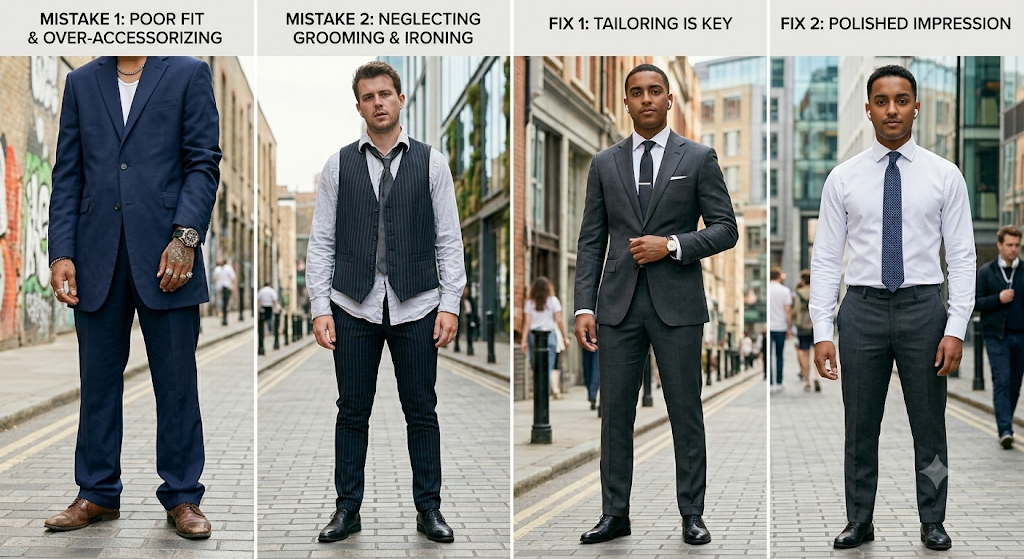
Introduction: Why Fashion Mistakes Hurt Your Professional Image
most men make fashion mistakes that damage their image without even realizing it. Wearing wrinkled clothes, mismatched shoes, ill-fitting shirts, or too many logos can make you look unprofessional, careless, or outdated.
After 10 years of writing content about fashion and lifestyle, I’ve observed that men’s fashion mistakes are more damaging than women’s because men’s fashion is simpler and more noticeable. When a woman makes a mistake, people focus on other things. When a man makes a mistake, it’s obvious immediately.
In this guide, I’ll break down the 12 most common fashion mistakes men make and how to fix them. Whether you’re 25 or 50, whether you’re a student or business owner, these mistakes apply to you. Let’s make sure you never damage your professional image because of clothing.
What Makes a Fashion Mistake?
A fashion mistake isn’t just wearing something “ugly.” It’s wearing something that sends the wrong message about you.
Fashion mistakes include:
- Clothing that doesn’t fit your body
- Wrong combinations (belt + shoe, shirt + pants)
- Poor maintenance (wrinkles, stains, scuffs)
- Inappropriate choices for occasion
- Cheap quality that looks bad
- Too much or too little style
The goal of men’s fashion: Look professional, confident, and put-together without trying too hard. Less is more.
12 Most Common Fashion Mistakes Men Make (And How to Fix Them)
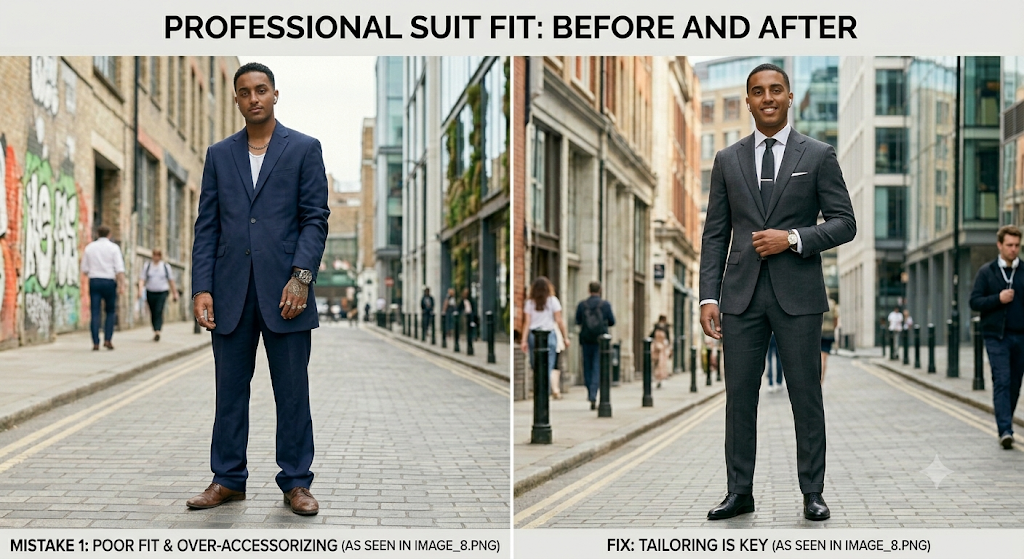
1. Wearing Clothes That Don’t Fit Properly
The mistake: Wearing clothes that are too tight OR too loose.
Why it’s bad:
- Too tight: Shows body shape negatively, uncomfortable, looks desperate
- Too loose: Looks sloppy, unprofessional, no structure
- Both: Destroys your entire silhouette
How to fix:
- Shirts: Should touch shoulders perfectly, sleeves end at wrist bone, no pulling at chest
- Pants: Should sit at natural waist, no gaping at back, length hits top of shoe
- Jackets: Shoulder seam hits edge of shoulder, sleeves end at wrist, closes without pulling
- T-shirts: Shoulders hit edge, not hanging down, not tight across chest
Pro tip: Buy your actual size, not “comfortable” size. If it’s uncomfortable, it’s wrong size.
Real impact: Well-fitting clothes make you look 10 years more professional immediately.
2. Ignoring Shoe Maintenance
The mistake: Wearing dirty, scuffed, or worn-out shoes.
Why it’s bad:
- People notice shoes first (they’re at eye level when sitting)
- Dirty shoes = careless, unprofessional
- Worn-out shoes = doesn’t care about quality
- Scuffed leather = looks cheap, even if expensive
How to fix:
- Clean weekly: Wipe with cloth, use shoe cleaner
- Shine monthly: Use leather polish for formal shoes
- Replace when: Heel worn, sole cracked, leather cracked
- Rotate: Don’t wear same shoes every day (gives them rest)
- Store properly: Use shoe trees, keep in dry place
Investment: Buy 3-4 quality shoes and maintain them. Don’t buy 10 cheap shoes.
Best shoes for men:
- Black leather (formal)
- Brown leather (business casual)
- White sneakers (casual)
- Brown loafers (summer casual)
3. Mixing Too Many Colors
The mistake: Wearing 4+ colors in one outfit.
Why it’s bad:
- Looks messy and uncoordinated
- Distracts from your face
- Shows lack of style knowledge
- Appears try-hard instead of confident
How to fix:
- Rule: Maximum 3 colors per outfit
- Base: 1 main color (pants, suit)
- Secondary: 1 second color (shirt, blazer)
- Accent: 1 small color (belt, watch, pocket square)
Example good outfit:
- Navy pants (color 1)
- White shirt (color 2)
- Brown belt + brown shoes (color 3)
Example bad outfit:
- Red shirt + blue pants + green belt + yellow shoes + orange watch (5 colors = messy)
Pro tip: Stick to neutral colors (navy, black, white, gray, beige) for business. Add 1 color for personality.
4. Wearing the Wrong Belt and Shoe Combination
The mistake: Wearing black belt with brown shoes OR brown belt with black shoes.
Why it’s bad:
- Classic fashion rule violation
- Shows you don’t know basics
- Looks uncoordinated
- Clients notice this immediately
How to fix:
- Black shoes = Black belt
- Brown shoes = Brown belt
- Match shades: Dark brown shoes + dark brown belt, light brown + light brown
Exception: Casual outfits (sneakers) don’t need belt Matching, but still better to match.
Pro tip: Buy 2 belts: 1 black, 1 brown. Use them based on shoe color.
Why it matters: Belt and shoe matching is the most basic fashion rule. Violating it shows you don’t understand basics.
5. Not Considering Body Type When Shopping
The mistake: Wearing what looks good on models, not on your body.
Why it’s bad:
-Everyone’s body is different
- What fits tall person doesn’t fit short person
- Slim clothes don’t work on heavier body
- Wrong fit = looks worse than regular clothes
How to fix by body type:
Tall men:
- Wear longer jackets (hits mid-thigh)
- Slim-fit pants (prevents looking too long)
- Avoid cropped clothes (makes you look taller)
Short men:
- Wear shorter jackets (hits waist)
- Slim pants (not baggy)
- Avoid oversized clothing (makes you look smaller)
- Monochrome outfits (creates length)
Heavier men:
- Wear structured clothes (not super slim)
- Dark colors (hide bulk)
- Avoid tight clothes (shows shape badly)
- Medium fit (not too tight, not too loose)
Slim men:
- Avoid super slim fit (looks like you’re hanging)
- Add texture (creates dimension)
- Medium fit works best
- Layering adds volume
Pro tip: Try everything before buying. Don’t assume size works for your body.
6. Wearing Wrinkled or Unironed Clothes
The mistake: Wearing clothes with visible wrinkles, creases, or stains.
Why it’s bad:
- Looks careless and lazy
- Shows you don’t care about appearance
- Unprofessional in business meetings
- Makes expensive clothes look cheap
How to fix:
- Iron after washing: Never put wrinkled clothes in drawer
- Hang properly: Use good hangers, don’t fold shirts
- Steam before wearing: Quick steam removes minor wrinkles
- Replace when: Fabric permanently wrinkled, can’t iron smooth
- Invest: Buy ironing board + good iron
Quick ironing tips:
- Shirts: Iron inside first, then collar, sleeves, body
- Pants: Iron along crease, both sides
- Jackets: Iron inside, avoid direct heat on outside
Pro tip: If you’re too lazy to iron, don’t wear it. Wrinkled clothes damage your image more than old clothes.
7. Overusing Accessories
The mistake: Wearing too many accessories (watch, multiple rings, multiple bracelets, necklaces, pocket squares, etc.).
Why it’s bad:
- Looks try-hard, not confident
- Distracts from your face
- Shows you’re uncomfortable in your own skin
- Professional people wear minimal accessories
How to fix:
- Rule: Maximum 3 accessories total
- Essential: 1 watch (most important)
- Optional: 1 belt, 1 ring, 1 pair of earrings (if worn)
- Avoid: Multiple bracelets, necklaces, pocket squares (unless formal)
Example good:
- Watch + belt = 2 accessories (perfect)
Example bad:
- Watch + belt + 3 rings + 2 bracelets + necklace = 7 accessories (too much)
Pro tip: Quality over quantity. 1 expensive watch > 5 cheap watches.
8. Wearing Sneakers With Formal Outfits
The mistake: Wearing white sneakers with suit, formal pants, or business attire.
Why it’s bad:
- Classic fashion rule violation
- Looks unprofessional in business
- Shows you don’t understand formality
- Clients judge you as careless
How to fix:
- Formal outfit (suit): Wear leather dress shoes (black or brown)
- Business casual: Wear leather shoes (brown, tan, oxford)
- Smart casual: Wear clean sneakers OR loafers
- Casual: Wear any sneakers
When sneakers ARE okay:
- Casual shirts + jeans
- Weekend outings
- Non-business meetings
- Informal events
When sneakers are NEVER okay:
- Client meetings
- Business presentations
- Formal events
- Office days (unless casual office)
Pro tip: Invest in 2-3 quality leather shoes. They’re more important than clothes.
9. Choosing Cheap Fabric Over Quality
The mistake: Buying clothes based on price, not fabric quality.
Why it’s bad:
- Cheap fabric wrinkles easily
- Cheap fabric loses shape quickly
- Cheap fabric looks cheap, even if new
- You replace cheap clothes often = spends more
How to fix:
- Check label: Choose 100% natural fibers (cotton, linen, wool)
- Avoid: 100% polyester, acrylic, cheap synthetics
- Better: Cotton-blend (80% cotton + 20% polyester) acceptable
- Best: 100% cotton, 100% linen, 100% wool
Fabric quality indicators:
- Weight: Heavier = better quality (within reason)
- Feel: Soft but structured = good
- Thread: Tight stitching = quality
- Color: Consistent, not patchy = good
Investment math:
- Cheap shirt: ₹500, lasts 6 months = ₹1,000/year
- Quality shirt: ₹1,500, lasts 3 years = ₹500/year
- You save money buying quality
Pro tip: Buy fewer quality pieces, not many cheap pieces.
10. Ignoring Seasonal Appropriateness
The mistake: Wearing winter clothes in summer OR summer clothes in winter.
Why it’s bad:
- Looks uncomfortable (you’re sweating or freezing)
- Shows you don’t understand weather
- Unprofessional in business
- Destroys fabric quickly
How to fix by season:
Delhi Summer (March-June, 35°C-45°C):
- Wear: 100% cotton, linen, light colors
- Avoid: Wool, dark colors, heavy fabric
- Examples: Cotton shirts, linen pants, light blazers
Delhi Winter (November-February, 8°C-25°C):
- Wear: Wool, cotton-wool blend, dark colors
- Avoid: Thin cotton, light colors only
- Examples: Wool blazer, cotton-wool shirts, thicker pants
Delhi Rain (July-October):
- Wear: Quick-dry fabric, water-resistant shoes
- Avoid: Thin cotton (gets soaked), leather shoes
- Examples: Rain jacket, water-resistant pants
Pro tip: Match fabric weight to temperature. Heavy fabric = cold weather, light fabric = hot weather.
11. Wearing Logo-Heavy Clothing
The mistake: Wearing clothes with giant logos, multiple brand names, or loud graphics.
Why it’s bad:
- Looks like you’re advertising, not dressing
- Unprofessional in business
- Shows you care about brand, not style
- Clients focus on logo, not you
How to fix:
- Business: No logos or minimal (tiny brand tag inside)
- Casual: 1 small logo acceptable
- Avoid: Giant logos across chest, multiple brand names, loud graphics
- Better: Solid colors, subtle patterns, no visible branding
Exception: Conservative logos (small Nike on sports wear, small Apple on tech) acceptable occasionally.
Pro tip: Real confidence doesn’t need logos. Quality fabric and good fit speak louder than branding.
12. Not Matching Outfit to Occasion
The mistake: Wearing casual clothes to formal events OR formal clothes to casual events.
Why it’s bad:
- Looks out of place
- Shows you don’t understand context
- Uncomfortable for you (too hot/cold/formal)
- Clients/hosts judge you negatively
How to fix by occasion:
Client meeting (business):
- Wear: Suit, formal shirt, leather shoes
- Avoid: Jeans, sneakers, casual shirts
Weekend casual outing:
- Wear: T-shirt, jeans, sneakers
- Avoid: Suit, formal shirt, dress shoes
Office day (semi-formal):
- Wear: Business casual (shirt + chinos + leather shoes)
- Avoid: Full suit (too formal) OR jeans (too casual)
Evening dinner (formal):
- Wear: Blazer, formal shirt, dress pants
- Avoid: T-shirt, shorts, sneakers
Religious place:
- Wear: Long pants, covered shoulders, closed shoes
- Avoid: Shorts, tank tops, sandals
Pro tip: Ask beforehand: “What’s the dress code?” Never assume.
Fashion Mistakes That Signal “Unprofessional”
Some fashion mistakes immediately signal “unprofessional” to clients. Be especially careful about these:
| Mistake | What It Signals |
| Wrinkled clothes | Lazy, doesn’t care |
| Dirty shoes | Careless, unhygienic |
| Ill-fitting clothes | Doesn’t understand basics |
| Too many colors | INsecure, tries too hard |
| Logo-heavy clothing | Unconfident, needs branding |
| Sneakers with suit | Doesn’t understand formality |
| Cheap fabric | Doesn’t invest in quality |
| Wrong belt + shoe | Doesn’t know basics |
| Wrong occasion outfit | Doesn’t understand context |
Impact: These mistakes make clients question your professionalism immediately. Fix them first.
How to Build a Foolproof Men’s Wardrobe
Building a wardrobe isn’t about buying everything. It’s about buying quality basics that work together.
Step 1: Start With Essentials (Buy These First)
| Item | Quantity | Why |
| White formal shirt | 2 | Works with any pants, suit |
| Black formal shirt | 1 | Evening, formal events |
| Light blue shirt | 2 | Business casual |
| White t-shirt | 3 | Everyday casual |
| Black t-shirt | 2 | Casual, night |
| Navy chinos | 2 | Business casual |
| Black formal pants | 2 | Formal meetings |
| Dark jeans | 2 | Casual weekends |
| Black leather shoes | 1 | Formal |
| Brown leather shoes | 1 | Business casual |
| White sneakers | 1 | Casual |
| Black belt | 1 | With black shoes |
| Brown belt | 1 | With brown shoes |
Total: 15-20 pieces = complete wardrobe
Step 2: Add Quality Layers
- Navy blazer: 1 (works with everything)
- Black blazer: 1 (formal events)
- Casual jacket: 1 (denim, cotton)
Step 3: Invest in Accessories
- Watch: 1 quality (most important)
- Sunglasses: 1-2 (UV protection)
- Wallet: 1 quality leather
Step 4: Maintain Everything
- Iron clothes regularly
- Clean shoes weekly
- Replace when worn
- Store properly
Pro tip: Buy 1 piece per month, not 10 pieces per week. Quality over quantity.
Best Investment Pieces for Men
These pieces are worth investing in because they last years and work everywhere:
| Piece | Why Invest | Best Price Range |
| Quality leather shoes | Last 5+ years, work everywhere | ₹3,000-₹10,000 |
| Well-fitted blazer | Professional, versatile | ₹4,000-₹15,000 |
| 100% cotton shirts | Comfortable, lasts long | ₹1,000-₹5,000 |
| Quality watch | Lasts lifetime, professional | ₹5,000-₹50,000+ |
| Good leather belt | Essential, lasts years | ₹1,000-₹5,000 |
| Dark jeans (quality) | Casual staple, versatile | ₹2,000-₹8,000 |
Total investment: ₹20,000-₹80,000 for complete quality wardrobe
Long-term value: You’ll spend LESS over 5 years buying quality vs. repeatedly buying cheap.
Final Thoughts: Dress Smart, Look Confident
Fashion mistakes don’t just make you look bad—they damage your professional image, reduce client trust, and hurt your business. As a business owner in Pitampura, Delhi, your appearance is one of your most powerful tools.
Key Takeaways:
✅ Fit is most important – Never wear clothes that don’t fit properly
✅ Shoe maintenance matters – Clean, shine, rotate shoes regularly
✅ Maximum 3 colors – Don’t mix too many colors in one outfit
✅ Match belt + shoe – Black = black, brown = brown
✅ Know your body type – Buy what fits YOUR body, not models
✅ Iron everything – Wrinkled clothes = unprofessional
✅ Minimal accessories – 1 watch + 1 belt = perfect
✅ No sneakers with formal – Wear leather shoes for business
✅ Quality fabric > cheap price – Invest in natural fibers
✅ Match occasion – Formal = formal, casual = casual
✅ Avoid logos – Solid colors look more professional
✅ Seasonal appropriateness – Summer = light fabric, winter = heavy fabric
Your Fashion Action Plan:
- This week: Audit your wardrobe. Identify mistakes
- Next month: Replace 2-3 worst items (dirty shoes, wrinkled shirts)
- Ongoing: Buy 1 quality piece per month
- Long-term: Build complete wardrobe of quality basics
Remember: Dressing well isn’t about being flashy—it’s about showing respect for yourself and your clients. When you avoid these fashion mistakes, you look professional, confident, and trustworthy.
Leave a Reply